
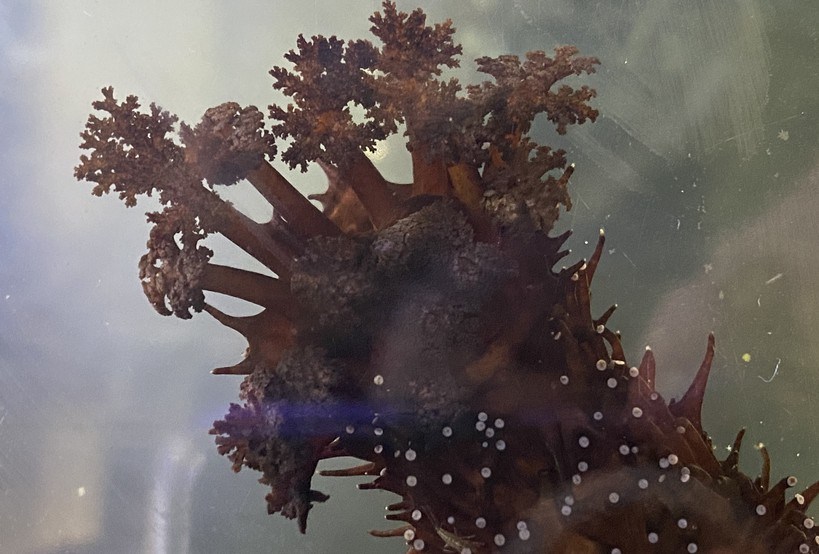
The fascinating sex life of sea cucumbers has come under the microscope as University of the Sunshine Coast researchers battle overfishing of the marine creatures.
Sea cucumbers – which can spawn by wobbling their heads and ejecting reproductive cells – are of particular interest to Centre for Bioinnovation PhD student Paul Wright.

Mr Wright’s research, published in an international journal, examines the idiosyncrasies of reproduction, important to understand when males and females of the species are externally identical.
“Being unable to tell sea cucumbers apart makes things tricky in a few ways, because you either have to see their insides or essentially take a blind guess,” Mr Wright said.
“In addition to getting the gender balance right, the ability of sea cucumbers to reproduce through the year fluctuates and can be quite unpredictable in captivity.
“When your ultimate goal is to find reliable ways of breeding them to help reach self-sustaining numbers, you don’t want to invest time and money in a stab-in-the-dark.
“Better understanding the biology of these rather mysterious creatures could help hatcheries select suitable broodstock and trigger spawning at the opportune time.”
Mr Wright’s research investigated a likely receptor for relaxin-like gonad-stimulating peptide (RGP), a natural prompt for the final stages of egg maturation and spawning.
The receptor study was part of a broader effort to improve reliable breeding in hatcheries and, in the longer term, support carefully designed restocking in the wild.
Global sea cucumber populations are threatened by their culinary and medicinal uses.
“The evidence we have assembled, therefore, has usefulness in both ecological and commercial settings, but restocking must go together with strong fishery management and habitat protection,” Mr Wright said.
Researcher Mr Wright boasts a colourful career path that includes time as a dive instructor, wedding photographer, real estate agent and mowing franchisee.
However, he has always maintained a passion for science and is motivated by the plight of the sea cucumber, which is in some respects an ‘ugly duckling’ of the ocean.
“A lot of people love whales and dolphins, but I believe the sea cucumber is just as fascinating and arguably even more essential to our ecosystems,” Mr Wright said.
“As they feed, they swallow and process sediment, recycle nutrients and mix the upper layers of the seabed.
“Removing large numbers of them removes this natural maintenance service, with consequences for the health and functioning of marine habitats,” he said.
The study has been published in the journal General and Comparative Endocrinology, while previous related research has been published in Zoological Science.